
The Missing Pillar of Climbing Training
“Conventional” climbing training - whatever that means - seems to frame all training using two variables: volume and intensity. “How much” and “how hard” - adjust these dials in the right proportion, and you’re promised maximum gains.
These are sound principles, and especially important for keeping athletes under a certain “injury threshold”, if you will. However, just like board climbing, volume and intensity are only two axes. And training, just like climbing, is far more than two dimensional.
A third variable that often seems missed or wrongly assumed - perhaps because it's harder to quantify than pitch counts or RPE - is relevance.
What makes turning the volume and intensity dials easy, is that you can really just “listen to your body”, as long as you’ve learned to understand the signals (granted, this takes experience). However, when considering relevance, you get little to no feedback day to day.
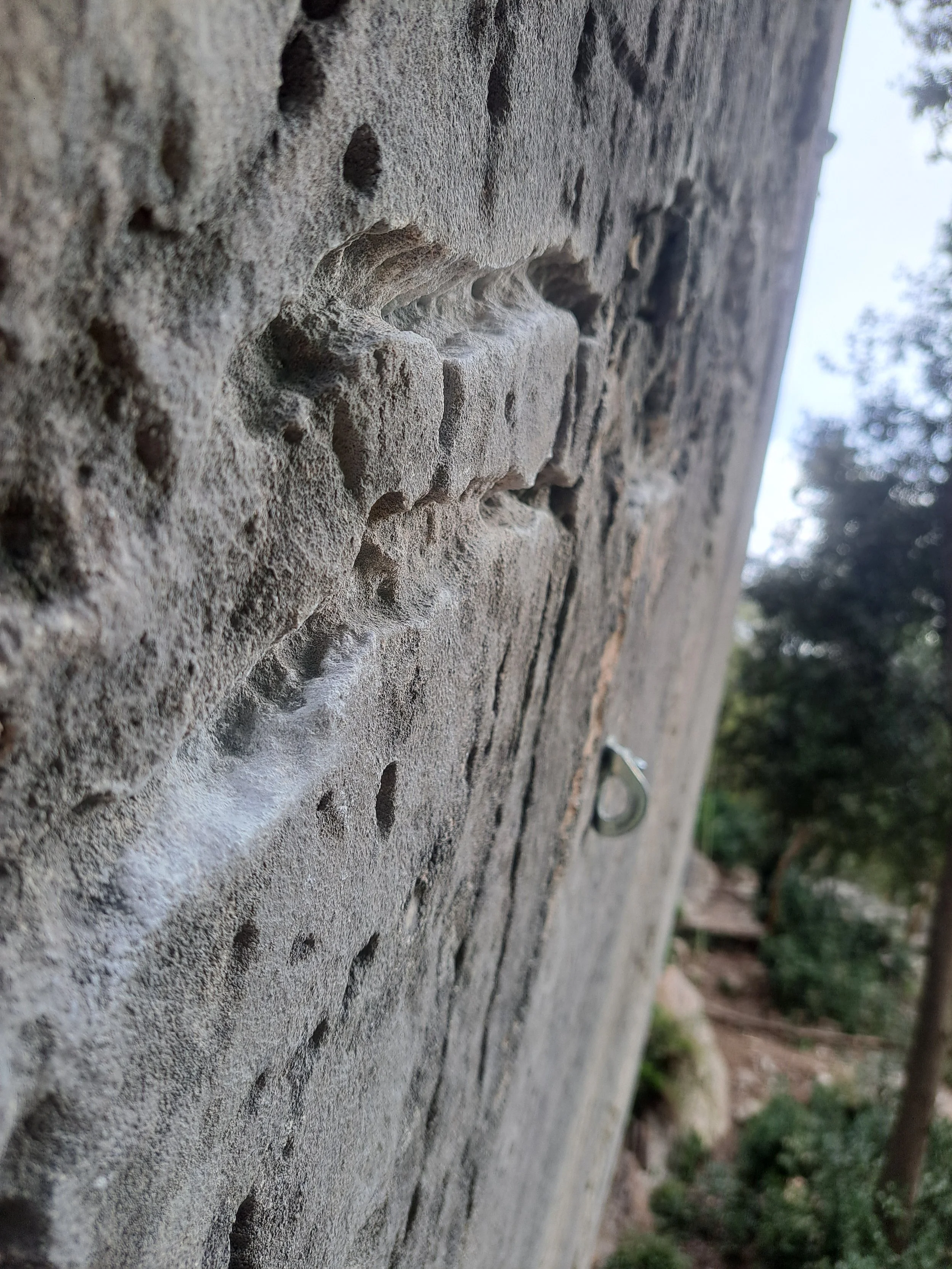
Start holds on the perfect limestone of “Pungitopo” (8c+/14c) in Arco, Italy
Relevance Defined
Relevance is the degree to which your training is specifically aligned with your particular needs for a goal. Not just "I want to climb a hard boulder so I train by climbing hard boulders", but far more specific. Consider the angle, the hold types, the movement patterns, the time under tension, the mindset, and other specific demands of the goals you have set.
Here's a useful example. Board climbing — Kilter, Tension, Moon, whatever you have access to — is one of the best training tools available. For most people, board volume and intensity are relatively straightforward - boards are demanding by nature, so they require lots of rest between attempts and between sessions. Try hard, rest lots.
But understanding how to use a board doesn’t address whether to use a board.
If you’re a sport or trad climber, it’s pretty rare for you to be climbing at consistent 45 degree angles, and more likely you’re climbing between vertical and 20 degrees, perhaps with a roof or bulge here and there. Yet, I’m not sure I’ve ever seen a board fixed at those angles.
If you’re a boulderer, it’s unlikely that you climb exclusively on sheer 2-D panes with drop offs, and probably safe to assume you have to top out at least 95% of what you climb. You probably also climb features, angles, and shapes, which give lots of dimension and allow for far more tricks and techniques than you’d find on a board.
One of my staple training workouts when I’m training for sport climbing is “Boulder-Shake-Repeat” (BSR’s). I set a timer and climb a boulder every 5 minutes for one hour - 12 boulders total. After each boulder, I immediately shake out on some holds or campus rungs for 2 minutes, and then sit to rest until it’s time for the next boulder. When I first started doing this session on a board, I found that my forearms, strangely, were recovering more while on the boulders than while resting on edges. Why?
Answer: Relevance.
To climb boulders on a 40 degree TB2 (what I was using) means mostly big holds - jugs, pinches, and good crimps. I remember a particular v6 that had a mandatory campus move. What on earth was that relevant to? I should have been doing the boulders on a 20 degree wall for it to transfer to my goals outside. Thankfully, the rest position I’d’ chosen with the campus rung was at a much more relevant angle. And resting capacity was the point of this workout, rather than any sort of power endurance or board skills.
Beastmaker Example
Most hard climbs require some level of finger strength. Suppose you’re climbing some amazing limestone in the fins, or in Ceuse. You think, “I’ll need to train on pockets”, which is reasonable.
So you go to the Beastmaker once/twice a week and do some hangs from the pockets. Even from the shallower, 20mm pockets. Relevant?
Somewhat.
Yes, you want to expose yourself and progressively load your fingers in those grips. However, if you get to a flat 20mm pocket on a vertical wall, like Demi Lune in Ceuse or the main wall of the Fins, you don’t need strength on it, you’re essentially at a rest. Such is the nature of vertical climbing. Instead, you need strength on the VERY shallow pockets, ones that are either very slopey or so small and incut that you have to full crimp them with just two fingers and a thumb. Now were all of those Beastmaker sessions relevant? Only somewhat.
Why This Matters
There are two core tenets of strength and conditioning. One is Progressive Overload. The other is Specific Adaptations to Imposed Demands (SAID Principle).
When the limestone climber was hanging on the Beastmaker pockets twice a week, they were well set up to practice progressive overload - just add a little more time or weight each week or block.
The same climber thought they were also adhering to the SAID principle, but specificity is a spectrum, and they could’ve been much further along it if they wanted to truly set themselves up to have the strength and resilience to operate at a high level outside, and not risk failure or injury.
When you do get injured or fail to meet a goal, sometimes it really is bad luck or accumulated fatigue. Often, though, there's a relevance factor that could have mitigated it. What you build in one context doesn't always transfer cleanly to another.
How This Shapes the Way You Train
Start by understanding the goal, so you can make sure the training is relevant to it. I think it’s quite common for people to first create their training based around ideas - stronger fingers, more endurance - and only after they’ve trained do they ask “what can I go do now?”
There’s nothing inherently “wrong” with this approach. However, I see two main inconveniences:
Training isn’t tailored to anything, meaning you aren’t getting as much out of it as possible.
When it does lead to success, the success comes from something you’ve only had in mind recently, as opposed to something you’ve had in mind for ages throughout your training. This makes your success less personally meaningful.
Final Thoughts
Volume and intensity are the easy dials. They have feedback loops — your body tells you when you’re pushing too much or too little.
Relevance is harder. It doesn’t give immediate signals. But when you get it right and make your training truly specific — like when I was resting from handmade toehook blocks in my garage to train for Southern Comfort years ago — and you go DO the thing, it’s more than feedback. It’s euphoria, validation, and meaning. It’s a return on your investments, not a gift card you chanced upon. Quite a different feeling, and in my experience, a more lasting one.
If you want help setting or training for a specific goal, that's exactly what my coaching is designed for.Book a free 20-minute consult and let's talk.
